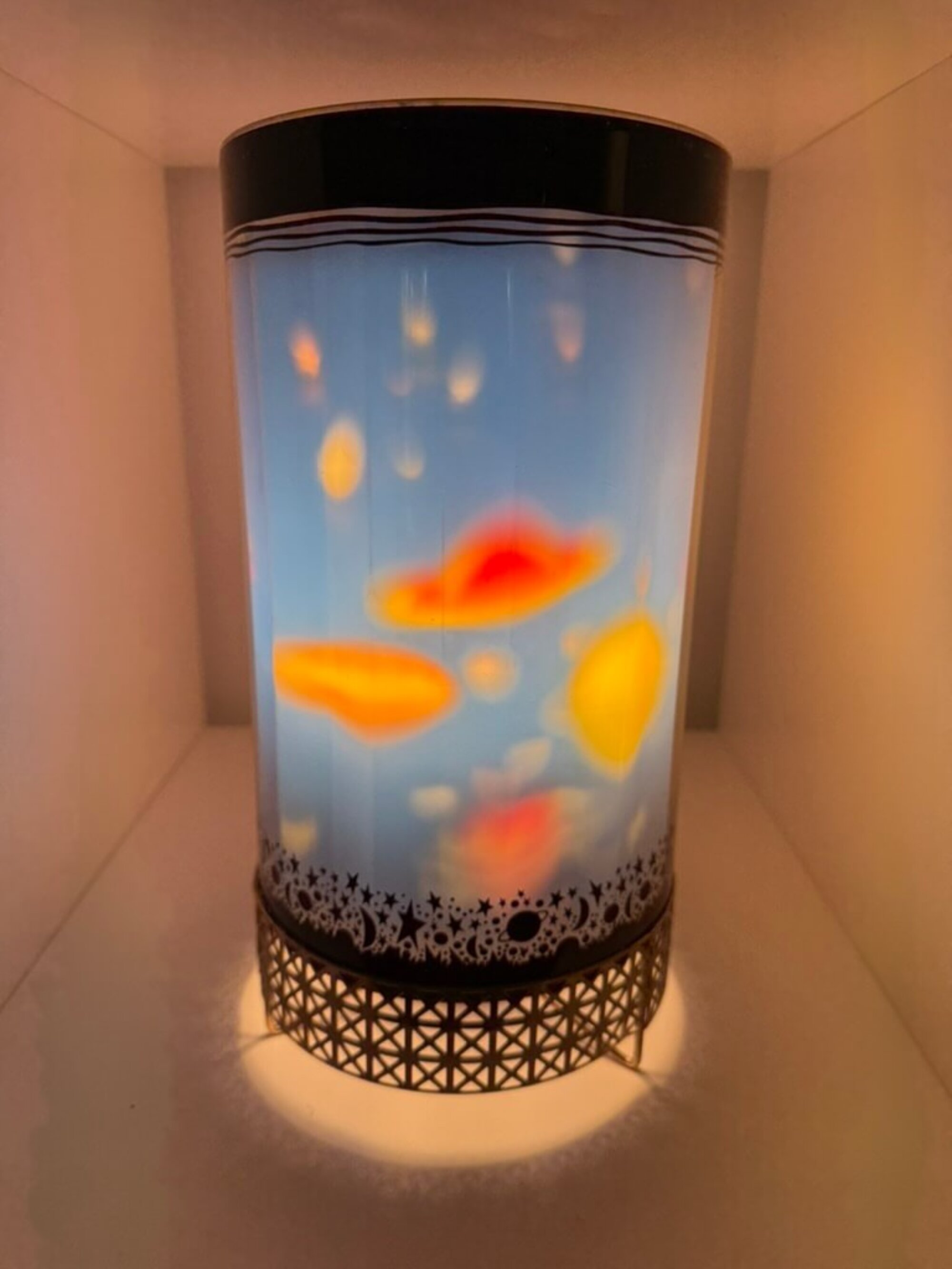


Description: Planets, some with rings, comets, and a flying saucer (?) seem to be rotating. We can see the Earth. The pleated sleeve creates a strange effect, as the planets appear wavy as they pass. The lampshade has a solar theme imprinted on the bottom.
Here, the base pattern differs from previous ones, featuring squares with inner crosses instead of circles.
Personal note: The lamp is considered a rare and collectible item, probably the most unique piece in my collection, and very hard to find.
Note that this is the only lamp I know of that addresses the theme of space. The explanation is straightforward: in the 1950s, space was still largely unknown. That said, a counterargument is necessary: even unknown space is a theme conducive to the imagination (which is the purpose of motion lamps: to let your imagination run wild while you listen to the radio). So, it’s a mystery to me why a lamp about space, like a book by Jules Verne, has not been more exploited by motion lamp creators.
I also like to think of this lamp as THE MOTION LAMP par excellence. And I even wonder if the designers took their thinking that far. Let me explain. A motion lamp works thanks to the heat from a light bulb, such as the… sun. The inner spinner revolves around the bulb: the planets!!! Q.E.D. (Quod erat demonstrandum).